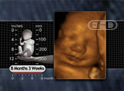
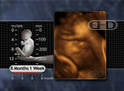
All ages referenced from date of fertilization, not last menstrual period.
Kirsten and Mark's Pregnancy Calendar

Journal Display Options: No messages have been posted yet.
|
| On March 18, 2008 (38 wks) the baby is due! |
|
|
|
|
|
| — | Breathing motions occur about 70% of the time. |
| — | Baby's foot is now about three inches long (about 7.5 cm). |
| — | Baby sometimes drinks 450cc (or 15 oz) of amniotic fluid each day. |
| — | Thighs are about three inches long (about 7½ cm). |
| — | The heart beats 54 million times before birth. |
| — | Time to be born! |
| — | Air breathing begins. |
|
[ View Images ]
[ Play Movies ]
|
|
|
|
|
|

|
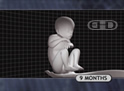
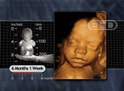
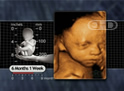
| On February 05, 2008 the 9th month (32-36 wks) begins. |
|
48 cm (19 inches) |
|
|
|
| — | Baby weighs about 2,500 grams (about 5½ pounds). |
| — | What the fetus hears during these last weeks of pregnancy, he or she may prefer later (e.g. Mom's voice). |
| — | Baby's feet are now 15 times their length at the age of 8 weeks. |
| — | Steady weight gain is a hallmark of the last weeks of pregnancy. |
| — | The fetus has a firm hand grasp. |
| — | Amniotic fluid volume peaks. |
| — | The number of heartbeats since conception is now greater than 50 million! |
| — | The belly is finally as big around as the head. |
| — | The brain weighs about 300 grams (a little less than ¾ pound). |
| — | Baby wieghs about 3,000 grams (about 6 pounds, 10 ounces). |
|
[ View Images ]
[ Play Movies ]
|
|
|
|
|
|
|
| On January 08, 2008 the 8th month (28-32 wks) begins. |
|
45 cm (18 inches) |
|
|
|
| — | After 40 million heartbeats, is a tuneup needed? |
| — | As fat stores increase, my wrinkles disappear. Thanks mom! |
| — | Feet now measure almost 2½ inches long (about 6 cm). |
| — | Breathing motions are common, even though there is no air in the womb. |
| — | The brain weighs about 200 grams (a little less than ½ pound). |
| — | Baby now weighs around 2,000 grams (almost 4½ pounds)! |
| — | The lifetime supply of the kidney's filtration units is now present. |
| — | The lungs produce "air pocket" cells from now until 8 years of age. |
| — | Prenatal food affects newborn taste preferences. |
|
[ View Images ]
[ Play Movies ]
|
|
|
|
|
|

|
| On December 11, 2007 the 7th month (24-28 wks) begins. |
|
40 cm (16 inches) |
|
|
|
| — | The thigh bone is about two inches long (about 5 cm). |
| — | baby now weighs about 1,000 grams (about 2 pounds, 3 ounces). |
| — | Baby's foot is now about two inches long (about 5 cm). |
| — | The eyes can detect low light and see in color. |
| — | The ability to smell has arrived. |
| — | The fetus can taste. |
| — | Between now and birth, brain weight increases 400% to 500%. |
| — | The eyes can produce tears. |
| — | The head is about the size of a softball. |
| — | Pupils react to light—just like newborns and big kids. |
| — | Body weight typically doubles from now until end of pregnancy. |
| — | Breathing motions are getting deeper and taking longer. |
| — | Baby now weighs about 1,500 grams (about 3 pounds, 5 ounces). |
| — | Baby can distinguish sounds of different frequencies. |
|
[ View Images ]
[ Play Movies ]
|
|
|
|
|
|

|
| On November 13, 2007 the 6th month (20-24 wks) begins. |
|
35 cm (14 inches) |
|
|
|
| — | Sometimes the eyes move rapidly just like eye movements seen in grownups having dreams. |
| — | Baby now weighs around 500 grams (about 1 pound, 2 ounces). |
| — | Starting this week, if born prematurely, survival is possible. |
| — | Heart beat count now exceeds 30 million beats! |
| — | The two sides of the brain are no longer symmetrical. |
| — | Sometimes breathing motions occur up to 44 times per minute. |
| — | The brain weighs about 100 grams (a little less than ¼ of a pound). |
| — | Sudden, loud noises trigger a blink-startle response. |
| — | The lungs produce a substance necessary for breathing after birth. |
| — | Loud noise increases movement, heart rate, and swallowing. |
|
[ View Images ]
[ Play Movies ]
|
|
|
|
|
|
|
| On October 16, 2007 the 5th month (16-20 wks) begins. |
|
28 cm (11 inches) |
|
|
|
| — | The fetal heart has now beat has more than 20 million times! |
| — | The head is about as big around as the average woman's wrist. |
| — | Sweat glands have arrived. |
| — | Certain movements in the larynx are similar to that of speaking. |
| — | A greasy white substance protects the skin from the amniotic fluid. |
| — | Girls’ ovaries now contain their lifetime supply of “egg” cells. |
| — | Melanin begins forming. |
| — | Movement, breathing, and heart rate follow daily rhythms. |
| — | The head is now the size of a tennis ball. |
| — | Hearing begins, as does response to sound. |
| — | All skin layers and structures are complete. |
| — | The eyelids separate, and eyes open and close. |
| — | Rapid eye movement occurs, just like adults when they dream. |
|
[ View Images ]
[ Play Movies ]
|
|
|
|
|
|
|
| On September 18, 2007 the 4th month (12-16 wks) begins. |
|
21 cm (8.3 inches) |
|
|
|
| — | The fetus is making more hormones all the time. |
| — | The entire fetus (except for parts of the scalp) responds to light touch. |
| — | Teeth are growing. |
| — | Girls open and close their jaws more often than boys of the same age. |
| — | Girls move their jaws more often than the boys do. |
| — | A pregnant mom may feel kicking for the first time. |
| — | If touched near the mouth, the face turns toward the side touched. |
| — | Girl fetuses move their jaws more often than boys do. |
| — | Nutrients in the amniotic fluid are broken down by digestive enzymes. |
| — | Blood cells begin replicating inside the bone marrow—just like big kids! |
| — | The head is bigger than a golf ball. |
| — | Baby's foot is now about one inch long (about 2½ cm). |
| — | Body fat emerges throughout the body. |
| — | Enamel begins forming on the developing teeth. |
| — | Air passages within the lungs are all formed. |
| — | The thigh bone (femur) is now about an inch long (or 2.5 cm). |
| — | The fetus produces stress hormones when poked with a needle. |
|
[ View Images ]
[ Play Movies ]
|
|
|
|
|
|
|
| On September 11, 2007 the 12th week begins. |
|
12 cm (4.7 inches |
|
|
|
| — | Weight increased by 60% this past week. |
| — | There are taste buds all over the mouth. |
| — | Hands touch the mouth as many as 50 times per hour. |
| — | Many different hormones are present. |
| — | Arms reach their final proportion to body size. |
|
[ View Images ]
[ Play Movies ]
|
|
|
|
|
|
|
| On September 04, 2007 the 11th week begins. |
|
10 cm (3.7 inches) |
|
|
|
| — | The face now makes complex expressions. |
| — | Now you can tell if it's a girl or boy! |
| — | Intestines absorb water and glucose from swallowed amniotic fluid. |
| — | The nose and lips are completely formed. |
|
[ View Images ]
[ Play Movies ]
|
|
|
|
|
|
|
| On August 28, 2007 the 10th week begins. |
|
8 cm (3 inches) |
|
|
|
| — | Yawning begins. (9 wks, 4 days) |
| — | Vocal cords are developing. (9 wks, 4 days) |
| — | Body weight increased more than 75% just this week! |
| — | Bones are hardening throughout the body. |
| — | Fingernails and toenails begin to grow! |
| — | The right and left sides of the brain are connecting. |
| — | Tiny folds in the skin form unique fingerprints. |
| — | The eyes roll downward after stimulation of the upper lid. |
|
[ View Images ]
[ Play Movies ]
|
|
|
|
|
|
|
| On August 21, 2007 the 9th week begins. |
|
6 cm (2.4 inches) |
|
|
|
| — | The mouth opens and closes, and the tongue moves. |
| — | The eyelids are now fused. (9 wks) |
| — | Swallowing amniotic fluid is beginning. (9 wks) |
| — | The fetus sighs, stretches, and moves the head. (9 wks) |
| — | Female fetuses have early reproductive cells in their ovaries. (9 wks) |
| — | Thumb sucking begins. (9 wks) |
| — | Grasping objects begins. (9 wks) |
|
[ View Images ]
[ Play Movies ]
|
|
|
|
|
|
|
| On August 14, 2007 the 8th week begins. |
|
4 cm (1.7 inches) |
|
|
|
| — | The hands touch each other, as do the feet! (7 wks, 4 days) |
| — | Knee joints have arrived. (7 wks, 4 days) |
| — | The fingers are free. (7 wks, 4 days) |
| — | The toes are free. (7 wks, 6 days) |
| — | Occasional breathing motions begin. (8 wks) |
| — | The skin thickens, losing transparency. (8 wks) |
| — | Some embryos are right-handed, some are left-handed. (8 wks) |
| — | Male embryos are already making testosterone! (8 wks) |
| — | The embryo floats and rolls over in the womb. (8 wks) |
| — | The embryo's joints are similar to adult joints. (8 wks) |
| — | The embryo has more than 4,000 parts (adults have about 4,500). |
| — | The embryonic period ends at 8 weeks, then the fetal period begins. (8 wks) |
| — | Hair grows on the brow and around the mouth. (8 wks) |
|
[ View Images ]
[ Play Movies ]
|
|
|
|
|
|
|
| On August 07, 2007 the 7th week begins. |
|
2 cm (0.8 inches) |
|
|
|
| — | Brainwave activity is reported. (6 wks, 2 days) |
| — | Collar bones and jaw bones begin to harden. (6 wks, 4 days) |
| — | The hands begin to move. (6 wks, 4 days) |
| — | The heart is nearly complete. (7 wks) |
| — | Testes are present. (7 wks) |
| — | Ovaries can be identified. (7 wks) |
| — | The head sometimes turns. (7 wks) |
| — | Fingers and toes emerge. (7 wks) |
| — | Hiccups may occur from now on. (7 wks) |
|
[ View Images ]
[ Play Movies ]
|
|
|
|
|
|
|
| On July 31, 2007 the 6th week begins. |
|
12 mm |
|
|
|
| — | Joints of the wrists are forming. (5 wks, 1 day) |
| — | Foot plates are present. (5 wks, 2 days) |
| — | Subtle movement begins. (5 wks, 5 days) |
| — | The heart's four chambers are easily seen. (5 wks, 6 days) |
| — | The face withdraws if lightly touched around the mouth. (6 wks) |
| — | The diaghragm is largely formed. (6 wks) |
| — | Electrical connections are forming in the spine. (6 wks) |
| — | The external ear is taking shape. (6 wks) |
| — | The appendix can be seen. (6 wks) |
|
[ View Images ]
[ Play Movies ]
|
|
|
|
|
|
|
| On July 24, 2007 the 5th week begins. |
|
8 mm |
|
|
|
| — | The brain's five main sections are visible. (4 wks, 4 days) |
| — | Cerebral hemispheres appear and begin to grow rapidly. (4 wks, 4 days) |
| — | The head makes up one third of the whole embryo! (5 wks) |
| — | The permanent kidneys are in place. (5 wks) |
| — | Hand plates have arrived. (5 wks) |
| — | Lung sections reflect the pattern of adult lungs. (5 wks) |
|
[ View Images ]
[ Play Movies ]
|
|
|
|
|
|
|
| On July 17, 2007 the 4th week begins. |
|
3 mm |
|
|
|
| — | The heart begins beating! (3 wks, 1 day) |
| — | Part of the thyroid gland appears. (3 wks, 1 day) |
| — | The amnion surrounds the embryo with a fluid-filled sac. (4 wks) |
| — | The umbilical cord is in place. (4 wks) |
| — | A tiny trachea or windpipe is forming. (4 wks) |
| — | The heart beats more than 100 times per minute. (4 wks) |
| — | Limb buds (soon-to-be arms and legs) appear. (4 wks) |
| — | Part of the brain that will control coordination is present. (4 wks) |
| — | The skin is so thin, you can see through it! (4 wks) |
|
[ View Images ]
[ Play Movies ]
|
|
|
|
|
|
|
| On July 10, 2007 the 3rd week begins. |
|
1 mm |
|
|
|
| — | The early heart can be seen. (20 days) |
| — | The brain has three major divisions. (3 wks) |
| — | Blood cells and blood vessels are forming. (3 wks) |
| — | The heart is shaped like a tube. (3 wks) |
|
[ View Images ]
[ Play Movies ]
|
|
|
|
|
|
|
| On July 03, 2007 the 2nd week begins. |
|
0.1 mm |
|
|
|
| — | The hormone hCG triggers a positive pregnancy test. (8 days) |
| — | Cells in the womb near the embryo are loaded with nutrients. |
| — | The amniotic sac begins forming. (10 days) |
| — | Implantation is complete and the placenta is starting to form. (12 days) |
| — | The embryo is now symmetrical about the midline. (13 days) |
|
[ View Images ]
[ Play Movies ]
|
|
|
|
|
|
|
| On June 26, 2007 the first week begins. |
|
Size: 0.1 mm |
|
|
|
| — | Development begins with a single-cell embryo at conception!!! (Age: 0 days) |
| — | One cell becomes two. (30 to 36 hours) |
| — | With 12 to 16 cells, the embryo is shaped like a tiny bunch of grapes. (3 days) |
| — | The site of the future back and chest can be seen. (4 days) |
| — | The embryo begins to implant in the womb. (6 days) |
|
[ View Images ]
[ Play Movies ]
|
|
|
|
|
|