|
|
|
|
|
- (2 weeks, 1 day):
 3 germ layers 3 germ layers- Cloacal membrane
- Primitive groove
- Rostral-caudal orientation
-
- (2 weeks, 2 days): Carnegie Stage 7
 Erythroblasts in yolk sac Erythroblasts in yolk sac- Three types of blood-forming cells in
- yolk sac
 Primordial germ cells Primordial germ cells Allantoic diverticulum Allantoic diverticulum- Allantoic diverticulum
- Amnion with two cell layers
- Notochordal process
- Secondary villi
-
- (2 weeks, 4 days): Carnegie Stage 8
 Foregut, midgut, and hindgut Foregut, midgut, and hindgut Uteroplacental circulation well Uteroplacental circulation well- established
 Prechordal plate with 1 retinal field Prechordal plate with 1 retinal field Brain is first organ to appear Brain is first organ to appear- Caudal eminence
- Neural ectoderm
- Neural groove and neural folds
- Notochordal and neurenteric canals
- Notochordal plate
- Connecting stalk
- Primitive pit (or notochordal pit)
- (2 weeks, 5 days):
- Prechordal plate with 2 retinal fields
-
- (2 weeks, 6 days): Carnegie Stage 9
- Numerous blood islands in umbilical
- vesicle
 Septum transversum (primitive diaphragm) Septum transversum (primitive diaphragm)- Foregut
- Oropharyngeal membrane
- Pharyngeal pouch 1
- Stomodeum forming
- Blood vessels emerge simultaneously in
- umbilical vesicle, embryo proper, amnion,
- and connecting stalk
- Common umbilical artery
- Dorsal aortae (paired)
- First pair of aortic arches
- Heart: Cardiogenic plate, cardiac jelly,
- myocardial mantle, and endocardial plexus
- Left ventricle, right ventricle,
- conotruncus
- Paired pericardial cavities
- Paired tubular heart
- Hindbrain with four rhombomeres
- Isthmus rhombencephali demarcates
- midbrain and hindbrain
- Mesencephalon (or midbrain)
- Neural cord within caudal eminence
- Neural groove deepens substantially
- Primary neuromeres
- Three main divisions of brain
- Cephalic and caudal folds
- Neural crest: Rostral and facial
- Primitive streak reaches neurenteric
- canal
- Somites with central somitocoels: Pairs
- 1 through 3
- Less Events...
|
|
|
|
|
- (4 weeks, 4 days): Carnegie Stage 14
- Thymus
 Parathyrogenic zones Parathyrogenic zones- Thyroglossal duct
- Thyroid pedical lengthens
 Dorsal contour develops depression at Dorsal contour develops depression at- level of sclerotomes 4 and 5
- Muscular plates between upper and lower
- limb buds
- Glomerular capsules, partially
- vascularized
- Mesonephric corpuscle
- Metanephrogenic cap emerges from
- ureteric bud
- Ureteric buds
- Angiogenesis within peri-esophageal
- mesenchyme
- Epiploic foramen
- Lesser sac (omental bursa)
- Small intestine forming coils
- Tongue: Hypopharyngeal eminence
 Arytenoid swellings (right and left) Arytenoid swellings (right and left)- Capillary network surrounds pulmonary
- mesenchyme
- Epithelial lamina of larynx
- Lungs: Right and left primary (or main
- stem) bronchi
- Mesenchyme covering esophagus and
- respiratory tree separates
- Mesenchyme surrounds bronchi
- Pleura (mesothelium) surrounds part of
- mesenchyme
- Right main bronchus longer than left
- Atria walls thin, ventricle walls thick
- and trabeculated
- Atrioventricula cushions not fused
- Common pulmonary vein drains pulmonary
- plexuses into left atrium
- Conotruncal ridges or cushions (remnants
- of cardiac jelly)
- Epicardium
- Left subclavian artery feeds left
- axillary artery, left vertebral artery,
- and and left thyrocervical trunk
- Outflow tract still with one lumen
- Posterior communicating arteries
- Pulmonary arch (sixth aortic arch) forms
- from aorta and aortic sac
- Pulmonary capillary network fed by
- pulmonary arteries, drain into left
- atrium
- Sinu-atrial (SA) node
- Superior mesenteric artery and vein
- Upper limb buds with early marginal
- blood vessel
 Brachial plexus Brachial plexus- Cervical plexus
- Dorsal roots
- Hypoglossal nerve roots unite (CN XII)
- Lens and retina invaginate to form optic
- cup
- Primordium of cochlear duct
- Rami communicantes
- Spinal nerves reach muscle primordia
- Upper limb buds innervated
- Pigment in retina (external layer of
- optic cup)
- D1 and D2 no longer identifiable within
- diencephalon
- 75% of midbrain covered by marginal
- layer
- All 16 secondary neuromeres
- Brain enlarges 50% since Carnegie Stage
- 13
- Brain: Cerebral hemispheres appear and
- begin rapid growth
- Brain: Lateral ventricles
- Cerebellum with intermediate and
- ventricular layers
- Cerebellum: Primordium found in alar
- plate of rhombomere 1
- Corpora striata primordia connected by
- commissural plate
- Cranial nerve 3
- Di-telencephalic sulcus
- Dorsal and ventral thalami
- Dorsal funiculus
- Hypothalamic sulcus
- Hypothalamus
- Mamillary region
- Medial and lateral longitudinal
- fasciculi
- Median ventricular eminence
- Pontine flexure
- Preoptic sulcus extends between optic
- evaginations
- Preoptico-hypothalamo-tegmental tract
- Primary meninx surrounds most of brain
- Rhombic lip
- Spinal cord wall with three zones:
- ventricular (ependymal) zone, mantle
- (intermediate) zone, and marginal zone
- Subthalamus with medial striatal ridge
- emerging
- Synencephalon
- Tegmentum
- Tentorium cerebelli, medial portion
- Terminal-vomeronasal crest contacts
- brain (olfactory area)
- Torus hemisphericus (TH)
- Velum transversum
- Ventral longitudinal fasciculus
- Ventral segment of hyoid arch subdivides
-
- (4 weeks, 5 days): Carnegie Stage 15
 Primordium of antitragus emerges from Primordium of antitragus emerges from- ventral subsegment of hyoid arch
- Gonad framework found in coelomic
- epithelium
- Thyroid detached from epithelium of
- pharynx in some embryos
- Lower limb bud rounded proximally and
- tapered distally
- Mesenchymal skeleton in upper and lower
- limbs
- Right and left neural processes
- Sclerotomic material around notochord
- (rhombomere D level)
- Vertebrae well defined
- Vertebral centra
- Primary urogenital sinus
- Ureteric bud extends to pelvis of the
- ureter
- Bladder and rectum are separating caudal
- to ureters
- Dense mesenchyme surrounds much of
- gastrointestinal tract
- Esophagus elongates, passes dorsal to
- carina and between main stem bronchi
- Gall bladder and cystic duct
- Liver: Hepatic ducts
- Ventral pancreas appears as an offshoot
- of the cystic duct
- Lobar bud swellings denote areas of
- secondary bronchi
- Remnants of coelomic epithelium forming
- visceral pleura
- Atrioventricular cushions apposed
- Blood flow divided into right and left
- streams through atrioventricular canal,
- ventricles, outflow tract, and aortic sac
- Blood vessels penetrate diencephalon
- Capillary plexus surrounds esophagus
- Capillary plexus surrounds lung buds
- Cardiac mesenchyme surrounds ventricles
- and outflow tract
- Coronary arteries (terminal end)
- Foramen secundum begins in septum primum
- Left ventricle with thicker walls and
- greater volume than right
- Right subclavian artery originates from
- brachiocephalic artery and feeds right
- thyrocervical trunk and axillary and
- vertebral arteries
- Semilunar cusps
- Capsule present around lens
- Corneal epithelium overlying optic cup
- Ear: Endolymphatic duct
- Geniculate and vestibulocochlear ganglia
- separating
- Lens body now present containing some
- lens fibers
- Lower limb buds innervated
- Optic stalk
- Utricle, endolymphatic duct, and
- endolymphatic sac
- Utriculo-endolymphatic fold
- External ear primordia emerges from
- caudolateral portion of mandibular arch
- Face: Lateral and medial nasal processes
- bilaterally
- Lateral nasal processes along
- dorsolateral lip of nasal pits
- Optic chiasm
- Adult lamina terminalis
- Amygdaloid area
- Cerebellar plate
- Cerebellum with marginal layer
- Fibers of dorsal funiculus reach level
- of C1
- First axodendritic synapses in cervical
- spinal cord
- First nerve fibers
- Habenular nucleus
- Habenulo-interpeduncular tract
- Lateral striatal ridge (derived from
- telencephalon and comprised mainly of
- neostriatum)
- Lateral ventricular eminence
- Locus caeruleus
- Longitudinal zones in diencephalon
- Marginal layer throughout most of
- diencephalon
- Material for sympathetic trunks
- scattered in cervical region
- Median striatal ridge (paleostriatum)
- Mesencephalic tract of CN 5
- Most cranial nerves seen
- Olfactory fibers reach brain
- Optic groove (also called preoptic
- recess)
- Postoptic recess
- Primordium of epiphysis
- Rhombomeres still identifiable
- Superior colliculi and its commissure
- Superior medullary velum
- Supramamillary commissure
- Synapses among motor neurons in spinal
- cord
- Tectobulbar tract
- Tentorium
- Third ventricle
- Trigemino-cerebellar tract
- Trochlear nerve root and decussation (CN
- IV)
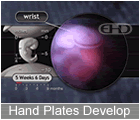
- Hand plate emerges from distal upper
- limb bud
 Frontonasal prominence Frontonasal prominence- (5 weeks):
- Arytenoid and epiglottal swellings
- Lobar pattern mimics adult pattern
- T-shaped laryngeal inlet
- Pacemaker cells
- Less Events...
|
|
|
|
|
- (6 weeks, 2 days): Carnegie Stage 18
- Angiogenesis begins inside gonads
- Gonad grows into oval shape with
- irregular surface
- Ostium (abdominal) of uterine tube at
- rostral end of paramesonephric duct (in
- female embryos)
- Paramesonephric duct forms from rostral
- end of mesonephric duct
- Testicular cords in gonads of male
- embryos
- Testicular cords in male gonad
- Elbow regions sometimes identifiable
- Embryo with cervical and lumbar flexures
- Embryo with dorsal concavity
- Finger rays with early interdigital
- notching
- Humerus, radius, and ulna
- Humerus: Chondrocytes in phases one
- through three
- Scapula and clavicle
- Semicircular ducts form in order:
- anterior, posterior, and lateral
- Sternum: Episternal cartilage created
- from fusion of right and left sternal
- bars
- Tibia and fibula
- Toe rays sometimes present
- Deltoid muscle
- External and internal abdominal oblique
- muscles
- Levator scapulae muscle
- Longus cervicis and semispinalis
- cervicis muscles
- Pectoralis major muscles
- Platysma muscle
- Rectus abdominis muscle
- Rectus capitus posterior and
- semispinalis capitis muscles
- Serratus anterior muscles
- Splenius and longissimus muscles
- Stapedius muscle
- "Common excretory duct is disappearing"
- Cloacal membrane ruptures (stages 18-19)
- Primordia of secretory tubules
- Esophagus with muscular and submucous
- coats
- Submandibular gland primordia
- Bronchial tree with subsegmental buds
- Bronchial tree with well established
- segmental bronchi
- Lingula of left upper lobe
- Aortic and pulmonary valves assuming
- shape of a cup
- Brachiocephalic veins, right and left
- Inferior vena cava
- Interventricular septum: membranous part
- begins forming
- Left coronary artery arises from aorta
- Mesenchyme ridges in place of future
- mitral and tricuspid valves
- Pulmonary and aortic blood flows
- completely separate
- Secondary interventricular foramen
- sometimes closing (stage 18-21)
- interventricular septum
- Septum secundum and foramen ovale
- (stages 18-21)
- Bucconasal membrane
- Bucconasal membrane detaches opening up
- nasal airway
- Crus commune
- Ethmoidal epithelium emerges from upper
- medial nasal wall
- Frontonasal angle (marks location of
- future nasal bridge)
- Mesenchyme thickenings mark beginning of
- "sclera and its muscular attachments"
- Nasal tip emerges
- Nerve fibers in retina
- Optic fibers
- Retina's outer lamina heavily pigmented
- Vomeronasal nerve and ganglion
- Vomeronasal organ marked by groove and
- located in fold of lower medial nasal
- wall
- Ear: Stapes primordium surrounds
- stapedial artery
- External ear: Crus helicis forming from
- auricular hillocks two and three (from
- mandibular arch)
- Eyelid folds sometimes present
- Nasolacrimal duct begins as epithelial
- strand emanating from nasomaxillary
- groove
- Nostrils, nasal wings, and nasal septum
- easily seen
- Olfactory bulb sometimes with olfactory
- ventricle
- Adenohypophysis no longer open to
- pharyngeal cavity
- Archistriatum
- Brain: Dentate nucleus in internal
- cerebellar swellings
- Brain: Pineal recess emerges
- representing anterior lobe of epiphysis
- Cerebrospinal fluid production begins
- Choroid plexuses in fourth and lateral
- ventricles
- Corpus striatum much larger extending to
- preoptic sulcus; has subtle groove
- External cerebellar swellings contain
- future flocculus
- Four amygdaloid nuclei
- Fourth ventricle: Choroid folds
- Hippocampus reaches olfactory region
- Interpeduncular fossa
- Neurohypophysis walls are folded
- Nucleus ambiguus of the vagus (CN10)
- Prosencephalic septum
- Red nucleus
- Substantia nigra
- Supra-optic commissure
- (6½ weeks):
- Volar pads on palms
-
- (6 weeks, 5 days): Carnegie Stage 19
- Greater thymic bud
- Cheeks form by merging of maxillary and
- mandibular processes
- Mammary gland primordium
- Mammary ridge disappears leaving only
- mammary gland primordium
- Female duct
- Gonads extend from levels T-10 to L-2
- Rete ovarii (in female embryos)
- Rete testis begins emerging from
- seminiferous cords (Stage 19-23) (in male
- embryos)
- Tunica albuginea in male embryos
- Suprarenal gland: Cortex
- Suprarenal gland: Medulla populated by
- prechromaffin cells
- Beginnings of occipital and sphenoid
- bones
- Bilateral cartilaginous sternal bars tie
- ribs together; sternal bars join
- cranially to form the episternal bar in
- the midline
- Cartilage within otic capsule envelops
- semicircular canals and cochlear duct
- Cartilaginous styloid process
- Ear: Cartilaginous malleus, incus, and
- stapes (the middle ear ossicles)
- Ectomeninx covers lateral and dorsal
- surfaces of brain (laying the foundation
- for the flat bones of the skull)
- Intervertebral discs form from caudal
- condensed portion of sclerotomes
- Ischium and illium
- Labiodental lamina: Inner dental lamina
- and outer labiogingival band
- Laryngeal cartilages
- Limbs point forward (ventrally)
- Orbitosphenoid cartilage located within
- ectomeninx near optic stalk
- Ossification begins in maxilla (stages
- 19 -20)
- Primitive palate (or intermaxillary
- segment)
- Rib primordia become cartilaginous
- Ribs each have an identifiable head and
- shaft
- Trachea: Tracheal cartilage
- U-shaped labiodental lamina form along
- upper and lower oral cavity
- Vertebral column represented by
- cartilaginous centrum, neural arch, and
- short tranverse process
- Esophagus: Muscularis layer adjacent to
- esophageal plexus
- Gluteal muscle group
- Iliopsoas muscles
- Infrahyoid muscles
- Internal intercostal muscles
- Limb extensor muscles located dorsally
- Limb flexor muscles located ventrally
- Midgut: Muscularis
- Muscle tissue forming around phrenic
- nerve within septum transversum portion
- of diaphragm
- Pharyngeal constrictor muscle
- Premuscle mass of the muscles of
- mastication innervated by mandibular
- nerve
- Quadratus lumborum muscle
- Rhomboid and scalene muscles
- Sternocleidomastoid and trapezius
- muscles distinct and innervated by
- separate branches of spinal accessory
- nerve (CN XI)
- Thenar and hypothenar eminences
- Tongue forms from swellings in floor of
- pharynx
- Tongue: Extrinsic muscles identifiable
- Tongue: Intrinsic muscles identifiable
- Transversospinal and erector spinae
- muscle groups
- Upper limb flexors innervated by
- musculocutaneous, median, and ulnar
- nerves
- Major calyces, cranial and caudal, with
- collecting tubules within metanephrogenic
- mass
- Mesonephros extends from T-9 to L-3
- Metanephros extends from T-12 to L-2
- Renal capsule covers distal collecting
- tubules
- Renal vesicles form in part of
- metanephros
- Ureter forms from "proximal segment of
- metanephric diverticulum"
- Urogenital sinus comprised of three
- parts: Bladder, pelvic, and phallic
- portions
- Anal folds adjacent to anal membrane
- Anal membrane
- Duodenum: "Assumes the shape of an arc"
- Greater omentum
- Lateral palatine process
- Liver: rapid growth, right side greater
- than left
- Median mandibular groove disappears as
- mandibular processes merge in midline
- Palatine fossa (from pharyngeal pouch 2)
- Primitive oral cavity
- Primitive rima oris replaces stomodeum
- Stomach wall layers: Mucosa, submucosa,
- muscularis, and serosa
- Submandibular and parotid gland buds
- Submandibular gland duct
- Bronchial tree: First generation of
- subsegmental bronchi complete
- Glottis, primitive
- Lung sac, right: Oblique and horizontal
- fissures define upper, lower, and middle
- lobes
- Lung sac: Apex and base
- Lung, left: Oblique fissure defines
- upper and lower lobes
- "Septum primum fuses with endocardial
- cushions" obliterating ostium primum and
- creating the ostium secundum
- Apex of left ventricle
- Circulus arteriosus (Circle of Willis)
- complete
- External iliac arteries
- Iliac lymph sac
- Intercostal and subcostal arteries
- Internal thoracic artery and
- costocervical trunk
- Mesenteric lymph sac
- Mesonephric artery feeds mesonephros,
- gonads, and suprarenal glands
- Papillary muscles
- Pontine, superior cerebellar, and
- anterior and posterior interior
- cerebellar arteries replace
- myelencephalic and metencephalic arteries
- Primitive marginal sinus drains
- diencephalon
- Primitive tentorial sinus drains
- cerebral vesical
- Primitive transverse and sigmoid sinuses
- Pulmonary arteries (right and left)
- Right coronary artery arises from aorta
- Splenic vein
- Tricuspid and mitral valves
- Anterior chamber between iridopupillary
- membrane and thickened ectoderm
- Auditory tube and primtive tympanic
- cavity form from tubotympanic recess
- pharyngeal pouch 1)
- Celiac, superior mesenteric, and
- inferior mesenteric preaortic ganglia
- Choana
- Cochlear duct tip grows upward
- Esophageal plexus formed by vagal nerves
- (CN X)
- Facial nerve (CN VII) branches: Chorda
- tympani, greater petrosal, posterior
- auricular, and digastric
- Facial nerve (CN VII) reaches
- cervicomandibular region
- Glossopharyngeal nerve (CN IX)
- innervates stylopharyngeus premuscle mass
- Hypoglossal nerve (CN XII) innervates
- separating tongue muscles
- Linguogingival groove
- Nasolacrimal duct forms from
- maxillonasal groove
- Nasolacrimal ducts extend from medial
- eyes to primitive nasal cavity
- Nerve fibers begin extending from retina
- Optic fibers enter chiasmatic plate
- Primitive nasal cavity
- Primordial vitreous body
- Superior, middle, and inferior cervical
- ganglia
- Trigeminal nerve (CN V) with opthalmic,
- maxillary, and mandibular divisions reach
- their destinations
- Vagal trunks, anterior and posterior,
- extending into abdomen
- Eyelids: Upper and lower lids present
- and growing
- Adenohypophysis: Lateral lobes of pars
- tuberalis
- Adenohypophysis: Pars intermedia
- emerging
- Brain: Internal capsule formation
- underway
- Cerebral hemispheres cover half of
- diencephalon
- Dorsal and ventral cochlear nuclei
- Fourth ventricle: Lateral recesses
- Ganglion of nervus terminalis
- Globus pallidus externus in the
- diencephalon
- Habenular commissure
- Intermediate layer in dorsal thalamus
- Lemniscal decussation
- Lower limb nerves (femoral, obturator,
- sciatic, common peroneal, and tibial)
- identifiable
- Medial accessory olivary nucleus
- Neurohypophyseal bud
- Nuclei of forebrain septum
- Nucleus accumbens
- Occipital pole of cerebral hemispheres
- Optic stalk with barely discernible
- lumen
- Paraphysis marks dividing line in roof
- between telencephalon and diencephalon
- Primitive filum terminale
- Radial nerve innervates upper limb
- extensors
- Rhombomeres no longer distinguishable
- Subcommissural organ
- Zona limitans intrathalamica between
- dorsal and ventral thalami
- (6 weeks, 6 days):
- Cloacal membrane ruptures
- (7 weeks):
 Head rotates Head rotates- Ovaries
- The heart has four chambers and is
- nearly complete.
- The heart rate peaks at 165 to 170 beats
- per minute.
- Crown-heel length 2.2 cm
- Less Events...
|
|
|
|
|
|
|
|
|
|
|
|
|
|
- (21 weeks):
- Periderm disappears
- Stratum corneum
-
- (22 weeks):
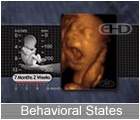
- Behavioral states
-
- (23 weeks):
- Brain weight 100 grams
-
- (24 weeks):
- Crown-heel length 34.5 cm
|
|
|
|
|
|
|
|
|
|
|
| Fertilization |
|
| Week 1 ends |
|
| Week 2 ends |
|
| Week 3 ends |
|
| Week 4 ends |
|
| Week 5 ends |
|
| Week 6 ends |
|
| Week 7 ends |
|
| Week 8 ends |
|
| Week 9 ends |
|
| Week 10 ends |
|
| Week 11 ends |
|
| Month 3 ends |
|
| Month 4 ends |
|
| Month 5 ends |
|
| Month 6 ends |
|
| Month 7 ends |
|
| Month 8 ends |
|
| Month 9 ends |
|
| Birth |
|
|
|
|
- (1 week, 1 day):
- Amnioblasts present; amnion and amniotic
- cavity formation begins
- Bilaminar embryonic disc
- Positive pregnancy test
-
- (1 week, 2 days): Carnegie Stage 5b
- Corpus luteum of pregnancy
- Cells in womb engorged with nutrients
- Exocoelomic membrane
- Isolated trophoblastic lacunae
- Embryonic disc 0.1 mm diameter
-
- (1 week, 4 days): Carnegie Stage 5c
- Intercommunicating lacunae network
- Longitudinal axis
- Prechordal plate
- Trophoblastic vascular circle
- (1 week, 5 days):
- Implantation complete
- Embryonic disc diameter: 0.15 to 0.20 mm
-
- (1 week, 6 days): Carnegie Stage 6
- Blood islands in umbilical vesicle
- Angiogenesis in chorionic mesoblast
- Blood vessels in villi
- Connecting stalk
- Primordial blood vessels
- Amnion with single cell layer
- Chorionic villi
- (2 weeks):
- Embryonic epiblast gives rise to
- primitive streak and primitive node and
- Yolk sac
- Yolk sac
- Less Events...
|
|
|
|
|
- (3 weeks, 1 day): Carnegie Stage 10
- Thyroid primordium emerges from floor of
- pharynx
- Nephrogenic cord emerges (at 10 somites)
- Cloaca
- Common coelomic cavity divides into
- peritoneal, pericardial, and pleural
- cavities
- Liver: Hepatic plate (endoderm)
- Midgut emerging
- Pharyngeal arches 1 and 2
- Pharyngeal cleft 1
- Second pharyngeal cleft and pouch
- Pharyngeal groove and ridge with
- laryngotracheal sulcus
- Respiratory outgrowth
- Atria (right and left) far apart
- Bulbis cordis
- Endocardial tubes fuse forming tubular
- heart
- Heart begins beating
- Pericardial sac
- Pericardium
- Primary head vein
- Sinus venosus
- Tubular heart begins folding
- Umbilical arteries
- Umbilical veins (right and left)
- Optic primordia fill neuromere D2
- Chiasmatic plate
- Mesencephalic flexure
- Neural tube
- Neuromeres D1 and D2 (in diencephalon)
- Optic sulcus in forebrain
- Pontine region identifiable near cranial
- nerves VII and VIII
- Segment D in rhombencephalon
- Some secondary neuromeres
- Superior colliculus
- Telencephalon
- Telencephalon (or telencephalic) medium
- Body cavities
- Hyoid arch
- Mandibular arch and maxillary process
- Neural crest: Trigeminal, facioacoustic,
- glossopharyngeal-vagal, and
- occipitospinal
- Somites: Pairs 4 through 12
-
- (3 weeks, 3 days): Carnegie Stage 11
- Primordial germ cells begin moving from
- umbilical vesicle to hindgut
- Face: Maxillary and mandibular processes
- (bilaterally)
- Cloacal membrane
- Mesonephric duct emerges from
- nephrogenic cord
- Nephric vesicles
- Cystic primordium
- Hepatic diverticulum
- Liver
- Membrane between future mouth and throat
- may begin to rupture
- Angiogenesis along surface of central
- nervous system
- Aortic sac
- Atrioventricular canal
- Capillary plexus begins forming around
- brain and spinal cord
- Conotruncus
- Conus cordis emerging from right
- ventricle
- Endocardium
- Heart contractions produce peristaltic
- blood flow
- Internal carotid arteries
- Interventricular septum
- Primordium of myocardium
- Sinus venosus separating from left atria
- Trabeculated outpouches along primary
- cardiac tube representing primordia of
- left and right ventricles
- Trigeminal and otic arteries
- Facio-vestibulocochlear ganglia (CN VII,
- CN VIII)
- Glossopharyngeal and vagal ganglia
- Optic evagination (starting at 14
- somites)
- Otic vesicle
- Trigeminal ganglia (CN V)
- Adenohypophysial pouch
- Adenohypophysis
- Lamina terminalis
- Mesencephalon contains tectum and
- tegmentum
- Neural crest production and migration
- continue
- Neurohypophysial primordia
- Neuropore (near brain) closes
- Notochord
- Segmentation of mesoblast alongside
- neural tube bilaterally
- Somites: Pairs 13 through 20
- (3 weeks, 3 days - 5 weeks, 6 days):
- All eight rhombomeres (Rh 1 through Rh
- 7, Rh D) - Present in stages 11 through
- 17
-
- (3 weeks, 5 days): Carnegie Stage 12
- Telopharyngeal bodies
- Alimentary epithelium invades stroma of
- liver
- Alimentary epthelium proliferates in
- primordia of stomach, liver, and dorsal
- pancreas
- First part of pancreas
- Gastric portion of foregut elongates (25
- to 28 somites)
- Hepatic primordium with abundant
- vascular plexus
- Omental bursa
- Oropharyngeal membrane is ruptured
- Pharyngeal arch 3
- Pharyngeal arches with dorsal and
- ventral parts
- Umbilical vesicle elongates
- Cervical sinus
- Laryngotracheal groove
- Lung bud
- Tracheo-esophageal septum
- Atrioventricular canal
- Common cardinal veins (right and left)
- Descending aorta
- Heart circulates blood to and from
- central nervous system, umbilical
- vesicle, and chorion
- Hepatocardiac channels (right and left)
- Rostral and caudal cardinal veins along
- brain and spinal cord feeding common
- cardinal veins
- Septum primum and foramen primum
- sometimes present
- Septum primum, foramen primum
- Sinu-atrial foramen prevents backflow
- into sinus venosus
- Sinus venosus collects veinous blood
- from entire embryo
- Superior vena cava, inferior vena cava,
- and sinus venosus collecting all venous
- blood
- Unidirectional circulation
- Vitelline arteries and veins
- Hypoglossal cord (CN XII) enters
- pharyngeal arch 4
- Otocyst nearly closed
- Nasal discs form part of ectodermal ring
- Brain involves 40% of neural tube
- Brain: Embryonic commissural plate
- Ectodermal ring complete
- Hypoglossal nucleus (CN XII)
- Lowermost spinal cord formation begins
- Mamillary recess
- Marginal layer in rhombencephalon
- Mesencephalic flexure at 90 degrees
- Mesencephalon with two neuromeres: M1
- and M2
- Motor neurons in basal plate of
- rhombencephalon
- Neural tube closes (lower back)
- Neurofibrils form in rhombencephalon
- Primary neurulation ends
- Primordia of ventral thalamus and
- subthalamus in diencephalon
- Sulcus limitans
- Sulcus limitans in midbrain
- Somites: Pairs 21 through 29
- Upper limb primordium at level of
- somites 8 to 10
- Progressively C-shaped embryo
-
- (4 weeks): Carnegie Stage 13
- Spleen primordia
- Thymic primordia
- Lower lip forms from merging of
- mandibular processes
- Melanoblasts in epidermis
- Gonadal ridge extends from C-7 to T-8
- levels
- Primordial germ cells migrate to
- mesonephric ridges
- Primordial germ cells number several
- hundred
- Urorectal septum
- Thyroid bilobed and attached to pharynx
- by thryoglossal duct
- Diaphragm primordia
- Glomeruli emerge in mesonephros
- Mesonephric duct attached to cloaca
- Nephric tubules now S-shaped
- Urogenital sinus
- Urorectal cleavage line
- Diverticulum ilei marks division between
- foregut and hindgut
- Intestines growing in length
- Mesentery from end of duodenum to
- proximal half of colon
- Opening between gut and umbilical
- vesicle decreases
- Pancreas: Ventral pancreas
- Pharyngeal pouches 1 through 4
- Pharynx
- Pleuroperitoneal canals
- Stalk of umbilical vesicle lengthens and
- narrows
- Stomach assumes shape of a spindle
- Umbilical vesicle at height of
- development
- Vitelline duct
- Bronchial buds
- Mesenchyme from coelomic epithelium
- surrounds esophagus and lung buds
- Trachea
- Anterior, middle, and posterior cerebral
- plexuses
- Aorta branches include dorsal
- intersegmental, lateral segmental, and
- ventral segmental arteries
- Aortic arches 4 and 6
- Artery from the common iliac artery
- feeds each lower limb bud
- Atrioventricular bundle
- Cardiac contractions still under
- myogenic control
- Celiac artery, superior and inferior
- mesenteric arteries
- Circulatory system "well established"
- Common iliac arteries (right and left,
- from dorsal aorta bifurcation)
- Contractions well coordinated and
- sequential from sinus venosus to atria to
- ventricles
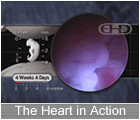
- Functioning two-chamber heart
- Gas exchange through placenta begins
- Gelatinous reticulum (or cardiac
- mesenchyme)
- Heart chambers bulging with fluid
- Heart now functions as two parallel
- pumps
- Heart: Atrioventricular cushions
- (rostroventral and caudodorsal)
- Heart: Myocardium wall 3 to 4 cells
- thick
- Primary head veins (right and left)
- drain anterior, middle, and posterior
- cerebral plexuses and feed precardinal
- veins
- Small arteries emerging throughout
- mesoderm
- Ventricle walls trabeculated
- Vertebral arteries
- Vitelline veins empty exclusively into
- hepatic plexus
- Most cranial nerve ganglia
- Trigeminal, glossopharyngeal, and vagal
- preganglia
- Otic invagination
- Terminal-vomeronasal neural crest
- Brain: Commissural plate
- Cerebellum
- Common afferent tract
- Fourth ventricle
- Interstitial nucleus (part of medial
- longitudinal fasciculus)
- Isthmus rhombencephali (a new neuromere)
- Oculomotor (CN III) and trochlear nuclei
- (CN IV) in mesencephalon (midbrain) and
- isthmus respectively
- Retinal and lens discs
- Amnion surrounds connecting stalk and
- vitelline stalk
- Hyoid arch sudivides into dorsal and
- ventral segments
- Limb buds - the first sign of arms and
- legs
- Lower limb buds
- Umbilical cord emerging
- Upper and lower limb buds
- Less Events...
|
|
|
|
|
- (5 weeks, 2 days): Carnegie Stage 16
- Apical epidermal ridges
- Mammary ridge
- Maxillary and premaxillary fields still
- widely separated
- Nipples emerge from mammary crest
- Gonad region separates from mesonephros
- Gonadal primordium
- Labioscrotal swelling
- Urogenital fold and groove
- Suprarenal gland: Cortex primordium
- Suprarenal gland: Medulla
- Thyroid detaches from pharynx
- Thyroid with right and left lobes
- connected by an isthmus
- Cartilage in mandibular arch
- Hand area with central carpal region and
- digital plate with marginal vein
- Pre-chondrocranium: Otic capsule, nasal
- capsule, and parachordal condensations
- Primordia of primary palate
- Ribs: Primordia now present for all 12
- pairs
- Vertebral column with 36 levels of
- ganglia and myotomes
- Extra-ocular premuscle masses receive
- cranial nerve fibers [oculomotor (CN
- III), trochlear (CN IV), and abducens (CN
- VI) nerves]
- Gluteal mesoderm
- Infrahyoid premuscle masses
- Limb mesoderm
- Sternocleidomastoid-trapezius premuscle
- mass with spinal accessory nerve (CN11)
- Thigh and thigh mesoderm
- Tongue premuscle mass
- Metanephros at level of sacrum
- Urethral plate
- Lesser omentum (ventral mesogastrun)
- Peritoneal cavity
- Rectum
- Stomach: Greater and lesser curvatures
- Yolk stalk disappears
- Bronchial tree expanding
- Cervical sinus diminished in size
- Epiglottis
- Primitive Larynx
- Anterior, middle, and posterior cerebral
- arteries
- Atrioventricular (AV) node
- Atrioventricular cushions fuse with
- interventricular septum
- Circle of Willis almost complete
- Conotruncal septum
- Endocardial cushions (rostroventral and
- caudodorsal) begin fusing around
- atrioventricular canal forming right and
- left atrioventricular canals and two
- separate blood streams
- External carotid artery
- Foramen primum disappearing
- Hepatic portal vein
- Infundibulum of right ventricle
- Jugular lymph sac
- Lateral atrioventricular cushions
- Mesencephalic artery
- Myelencephalic artery
- Perilental blood vessels
- Primitive cavernous sinus drains
- primitive maxillary and supraorbital
- veins
- Primitive renal plexus
- Right ventricle feeds sixth (pulmonary)
- aortic arches; left ventricle feeds
- fourth aortic arches
- Semilunar valves (aortic and pulmonary)
- are forming
- Ventricles each with three parts: inlet,
- trabecular pouch, and outflow tract
- Ventricles enlarge and deepen
- side-by-side forming an ever growing
- interventricular septum
- Celiac plexus
- Cochlear nerve present
- Femoral and obturator nerves innervate
- rostrolateral part of lower limb
- Hypoglossal nerve (CN XII) reaches
- tongue
- Intercostal nerves
- Lumbar and sacral plexuses
- Musculocutaneous, radial, ulna, and
- median nerves enter upper limb bud
- Nasal pits face more ventrally, still
- widely separated
- Nasofrontal groove
- Olfactory fibers connect nasal pits with
- brain
- Olfactory fibers enter brain
- Olfactory tubercle present
- Peroneal and tibial nerves innervate
- caudomedial part of lower limb
- Phrenic nerve
- Pigment in retina visible externally
- Primordium of cochlear pouch
- Tibial nerve innervates foot area
- Auricular hillocks on hyoid arch
- (antitragus and helix)
- Auricular hillocks on mandibular arch
- (tragus and crus)
- Alar lamina emerging with dense rhombic
- lip
- All cranial nerves identifiable
- Archipallium, paleopallium, and
- neopallium
- Area epithelialis
- Brain: Primordial plexiform layer in
- area of future temporal lobe
- Cajal-Retzius cells
- Commissure of the trochlear nerve
- Diencephalic subthalamic nucleus
- Dorsal and ventral thalami separated by
- groove
- Dorsal funiculus fibers reach medulla
- oblongata
- Epiphysis cerebri
- Glial cells identifiable adjacent to
- neurons
- Greater petrosal nerve
- Hippocampus: Gyrus dentatus
- Infundibular recess and infundibulum
- Interventricular foramen large
- Marginal ridge
- Medial and lateral ridges of corpus
- striatum are continuous
- Median forebrain bundle
- Neurohypophysial outgrowth
- Olfactory tubercle
- Pontine flexure deepens
- Posterior commissure
- Recurrent laryngeal nerve
- Reticular formation more defined
- Retinal fissure closes
- Splanchnic nerve
- Sulcus limitans hippocampi
- Superior laryngeal nerve
- Second pharyngeal arch more prominent
- Third pharyngeal arch recedes
- (5½ weeks):
- Initial tooth formation
- (5½ weeks - 6 weeks):
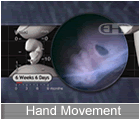
- Subtle movement begins
- (5 weeks, 5 days - 7 weeks, 1 day):
- Melanocytes in epidermis
-
- (5 weeks, 6 days): Carnegie Stage 17
- Facial growth centers grow and begin
- merging forming nose and upper jaw
- Genital eminence forms phallus or
- genital tubercle
- Gonad grows into oval shape with
- irregular surface
- Auditory ossicles identifiable in
- mesenchyme
- Cartilage in occipital sclerotomes (1-4)
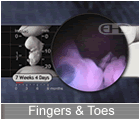
- Digital rays in hand plate
- Femur: Chondrification begins
- Foot with rounded digital plate
- Hypoglossal foramen (or canal) through
- sclerotome 4 (area of future occipital
- bone)
- Odontogenic epithelium ermerges in six
- areas (four maxillary and two mandibular)
- Primary palate components (right and
- left) fuse in midline
- Primitive palatine groove
- Primordium of cartilage within nasal
- septum
- Vertebral centra begin chondrification
- Primordia of orbital muscles
- Calices
- Mesonephros can produce urine
- Pelvis of the ureter with three main
- divisions
- Vesico-urethral canal
- Biliary ducts within liver
- Dorsal and ventral pancreas fuse but
- retain separate ducts
- Duodenum enlarges proximal to and distal
- to bile and pancreatic ducts
- Esophagus developing a submucous coat
- surrounding epithelium
- Intestinal loop begins umbilical
- herniation
- Primordial vermiform appendix
- Stomach regions include gastric canal,
- fundus, corpus (or body), and pyloric
- antrum
- Trachea: Precursors of tracheal
- cartilages
- Condensing mesenchyme around junction
- between left and right atria and cardiac
- tube is precursor to mitral and tricuspid
- valves
- Outflow tract rotates counterclockwise
- Right and left atrioventricular canals
- totally separated
- All parasympathetic cranial nerve
- ganglia identifiable
- All spinal nerves present
- Cell islands in olfactory tubercle
- Crescentic lens cavity
- Geniculate ganglion separate from
- vestibulocochlear nerve
- Globular process emerges from each
- medial nasal process
- Nasal fin connecting nasal disc and
- surface epithelium
- Nasofrontal grooves
- Olfactory tubercle with cellular islands
- Capillaries between adenohypophysis and
- hypothalamus
- Commissure of the oculomotor nerves
- Cortical nucleus in amygdaloid body
- Dentate and isthmic nuclei in cerebellum
- Dura begins forming in basal area
- Epiphysis cerebri with intermediate
- layer
- First hint of septal nucleus
- Frontal and temporal poles of cerebral
- hemispheres
- Gustatory fibers separate from common
- afferent tract
- Hemispheric stalk
- Intermediate layer in tectum
- mesencephali
- Interventricular foramen
- Mesencephalon with intermediate layer
- Somites: Pairs 38 and 39
- Spinal cord reaches caudal tip of body
- Subarachnoid space
- Synapses in spinal cord between
- interneurons and primary afferent neurons
- Ventral thalamus with intermediate layer
- (6 weeks):
- Blood forming in liver
- Milk lines
- Handplates develop subtle flattening
- Medial skull cartilages: Parachordal,
- hypophyseal, and trabecular
- Tooth buds (primary teeth)
- Intestines fill base of umbilical cord
- Crown-heel length 1.6 cm
- Less Events...
|
|
|
|
|
- (7 weeks, 1 day): Carnegie Stage 20
- Facial processes no longer
- distinguishable
- Ovaries full of primitive oogonia,
- intermediate pregranulosa cells, and
- mesenchyme
- Testes with short straight tubules
- Upper limbs with slightly flexed elbows
- Diaphragm: Central tendon
- Renal vesicles with S-shaped lumina
- Submandibular gland: Solid epithelial
- ducts enlarge and begin to branch
- Adenohypophysis with new capillaries on
- rostral surface
- Scalp vascular plexus
- Cochlear duct tip growing horizontally
- Lens cavity completely filled
- Optic commissure
- Optic fibers extend to optic chiasma
- Brain: Inferior colliculus (in
- mesencephalon)
- Cerebral hemispheres expand beyond
- lamina terminalis
- Cerebral hemispheres extend over
- two-thirds of diencephalon
- Interpeduncular groove
- Medial septal nucleus
- Nigrostriatal fibers
- Nucleus of diagonal band
- Sacrocaudal spinal cord formation
- (secondary neurulation) complete
- Sensory pathways: Cuneate and gracile
- decussating fibers
- Septum verum
- Spinothalamic tract
- (7 weeks, 1 day - 8 weeks):
- Stomach: Folds in stomach wall
- (7 weeks, 2 days):
- Arteries and veins of heart complete
-
- (7 weeks, 3 days): Carnegie Stage 21
- Volar pads begin to emerge on fingertips
- Chondrocranium with dorsum sellae and
- hypophysial fossa
- Dens (of second cervical vertebrae)
- Sternoclavicular joint and manubrium
- Trachea: Thyroid cartilage
- Wrists slightly flexed
- Gluteus medius and gluteus minimus
- muscles
- Iliacus muscles
- Mylohyoid and infrahyoid muscles
- Orbicularis oculi muscles
- Submandibular gland: Solid ducts with
- definitive branches
- Anterior and posterior choroid arteries
- Left superior vena cava disappears
- (Stages 21-23)
- Scalp vascular plexus moving toward
- vertex
- Cornea: Substantia propria layer
- Fibers of optic nerve reach brain
- Eyelids growing rapidly
- Anterior and inferior horns of lateral
- ventricle
- Brain: Insula within cerebral hemisphere
- C-shaped lateral ventricle
- Cerebral hemispheres cover 75% of
- diencephalon
- Cerebral hemispheres cover more than
- half of diencephalon
- Cortical plate within primordial
- plexiform layer
- Glial and neurilemmal (Schwann) cells
- within cranial nerves
- Global pallidus internus
- Internal fiber layer of cerebellum
- Lateral olfactory tract
- Primordium of dentate nucleus
- Pyramidal cells in hippocampus
- Subthalamic nucleus proper,
- entopeduncular nucleus, and globus
- pallidus externus within subthalamus
- Sulcus transversus rhombencephali
- Ventral part of lateral geniculate body
- (7½ weeks):
- Fingertips thicken
- Plantar pads toes
- EKG pattern similar to adult
- (7 weeks, 5 days):
- Endolymphatic and jugular foramina
- Hands can reach one another and fingers
- can overlap
- Optic foramen, foramen rotundum,
- internal acoustic foramen
- Osteoblasts emerge
- Pelvis: Obturator foramen
- Obturator internus muscles
- Rectus femoris muscle
- Large glomeruli present within
- metanephros
- Submandibular gland: Secondary branching
- with lumen formation starting at oral end
- of duct
- Costodiaphragmatic recess of pleural
- cavity
- Chordae tendineae (Stages 22 and 23)
- Intradural veins (sinuses)
- Scalp vascular plexus 75% of the way to
- the vertex
- Cochlear duct's second loop growing
- upward
- Scleral condensation
- Tragus and antitragus taking shape
- Eyelids continue growing rapidly over
- the surface of the cornea
- Brain: Claustrum
- Brain: Cortical plate within cerebral
- hemispheres
- Brain: Internal capsule with connections
- to epithalamus, dorsal thalamus, and
- mesencephalon
- Brain: Putamen
- Cerebral hemispheres cover 75% of
- diencephalon
- Commissural plate thickens
- Cortical plate expanding rapidly
- Folds in roof of third ventricle
- Nerve fibers between neopallial subplate
- and internal capsule
- Thalamocortical fibers
-
- (8 weeks): Carnegie Stage 23
- Ductus deferens
- Interstitial cells forming within testis
- Testicular tubules
- Male embryos are making testosterone
- already!
- Anterior inferior iliac spine
- Costal cartilage
- Enamel organ
- Femur: Head and acetabular fossa
- Glenoid fossa
- Greater trochanter
- Head of humerus
- Inguinal ligament
- Joint development: Cavitation underway
- in hip, knee, and ankle (in some embryos)
- Joint development: Cavitation underway
- in shoulder, elbow, and wrist (in some
- embryos)
- Nucleus pulposus (from notochord)
- Ossification underway in scapula and
- distal phalanges in some embryos
- Pubic symphysis
- Scapular spine and notch
- Skull: Foramen magnum (wide)
- Skull: Ossification underway in some
- embryos
- Superior and inferior pubic rami
- Ulna: Styloid process and olecranon
- Vertebrae cartilaginous (33 or 34 in
- number)
- Anterior digastric muscles
- Depressor anguli oris muscle
- Esophagus: Longitudinal muscles
- Obliquus superior capitus muscle
- Obturator externus, gluteus maximus, and
- hamstring muscles
- Posterior belly of the digastric muscle
- Psoas tendon
- Rectus sheath with anterior and
- posterior lamina
- Temporal and lateral pterygoid muscles
- Zygomaticus major muscle
- Kidneys at level of first three lumbar
- vertebrae
- Metanephros: Numerous large glomeruli
- Metanephros: Secretory tubules
- elongating and becoming convoluted
- Sinusal tubercle
- Urethra
- Gastrolienal ligament
- Nerves reaching intestinal loop
- Submandibular gland: Lumen present in
- terminal portions of duct
- Submandibular gland: Mesodermal sheath
- surrounds gland
- Unfused uvula (edge of unfused palatine
- shelf) and secondary palate
- Pseudoglandular stage begins
- Azygos vein
- Blood supply to the brain closely
- resembles adult pattern
- Hemiazygos veins
- Inferior epigastric artery
- Inferior vena cava valve at junction of
- right atrium
- Scalp vascular plexus nearing vertex
- Submandibular glands: Angiogenesis
- begins around epithelial tree (ducts)
- Superior sagittal sinus
- Cochlear duct's 2.5 coils nearly
- complete
- Cranial nerve distribution mimics adult
- pattern
- Eye: Secondary vitrous body
- Lens: Secondary lens fibers emerging
- Retina: Eight layers present
- Retina: Four of the ten adult layers
- present
- Tympanic membrane
- Eyelids fusing laterally and medially
- Optic tract reaches ventral portion of
- lateral geniculate body
- "The rhombencephalon...presents striking
- resemblance to that of the newborn."
- Amygdala area
- Brain represents 43% of embryo
- Brain: Caudate nucleus and putamen
- within corpus striatum
- Cerebellar commissures
- Cerebellum with external germinal layer
- Cerebral hemispheres cover lateral
- portion of diencephalon
- Choroid plexus now lobular
- Cortical plate covers nearly all of
- neopallial surface
- Dura lines entire vertebral canal
- Fasciculus cuneatus and fasciculus
- gracilis form the decussation of the
- medial lemnisci
- Greater palatine nerve
- Grey and white matter
- Hippocampus reaches temporal pole
- Inferior and superior cerebellar
- peduncles
- Most cisterns present
- Principal nucleus of inferior olivary
- nuclei
- Pyramidal decussations
- Right- and left-handedness emerges
- Suprapineal recess
- Suprascapular nerve
- Vermis of cerebellum
- Crown-heel length 4.3 cm
- Embryonic Period Ends
- The 8-week embryo has formed more than
- 4,000 permanent body parts.
- Less Events...
|
|
|
|
|
|
|
|
|
|
|
- (18 weeks):
- Apocrine sweat glands
- Sweat glands
-
- (19 weeks):
- Melanin production
- Sulci on surface of cerebral hemispheres
-
- (20 weeks):
- Peyer's patches
- Surfactant production (low levels)
- Crown-heel length 28 cm
- Head circumference 20 cm
|
|
|
|
|
- (25 weeks):
- Intestinal lining contains all adult
- cell types
-
- (26 weeks):
- Terminal sac stage begins
-
- (28 weeks):
- Crown-heel length 39.5 cm
|
|
|
|
|
- (36 weeks):
- Surfactant production accelerates
- Brain weight 300 grams
- Crown-heel length 48.5 cm
|
|
|
|
|

